








요약:
어떤 공구 가방이 자신의 직업에 적합한지 잘 모르시겠나요? 전기 기술자부터 목수까지, 내구성, 수납 공간, 일상적인 작업 요구 사항을 고려하여 완벽한 가방을 고르는 방법을 알아보세요.
The right tool bag should make your everyday tools easier to find, carry and protect. Start with the tools you actually use, the distance you carry them and the conditions on your jobsite. A large pocket count is useful only when the pockets fit your equipment and let you retrieve it without emptying the bag.
This guide explains how to compare tool bag formats, materials and layouts, whether you are choosing one bag for yourself or standardizing equipment for a crew.
Start with your daily tool inventory
Lay out your normal working kit, rather than every tool you own. Separate frequently used hand tools, bulky items, delicate instruments and small consumables. Measure the longest tool and the largest item that must fit inside. Remember that external bag dimensions do not tell you the usable size of every internal compartment.
- Daily essentials: keep the tools you reach for repeatedly in visible, accessible pockets.
- Occasional equipment: use a separate pouch or larger carrier when it would otherwise crowd the everyday kit.
- Small parts: plan removable containers or zipped pouches instead of letting loose fasteners collect at the bottom.
- Delicate equipment: look for separation from sharp tools and verify the protection required by the equipment manufacturer.
Choose a format that suits how you work
Open-top tool totes
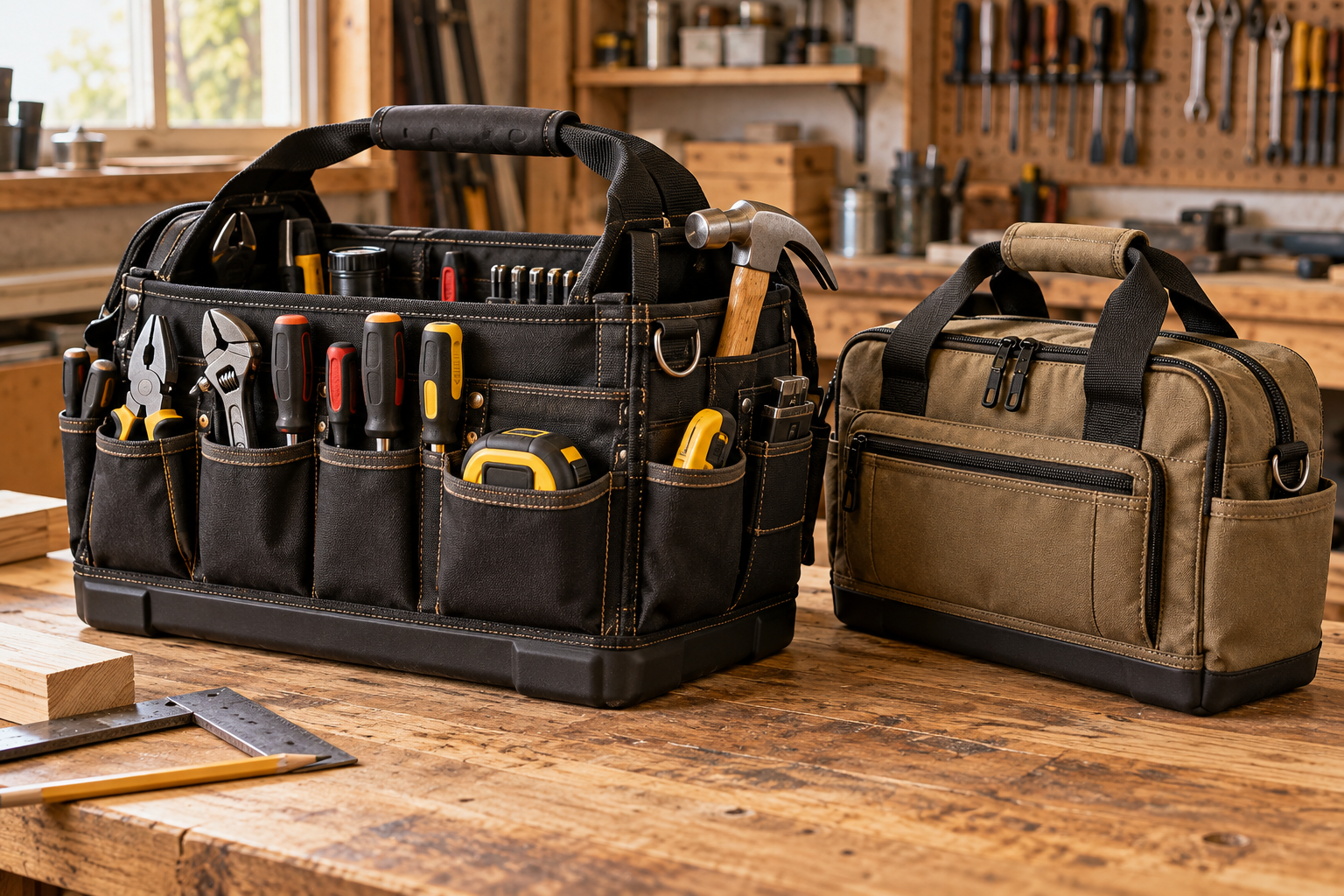
An open tote gives quick access when the bag sits beside a workbench or installation area. A stable base and a clear pocket layout matter more than extra pockets you cannot see. Open designs provide less enclosure during transport, so consider how you will keep contents secure and protected between jobs.
Zippered tool bags
A closed carrier is useful for vehicle storage and moving between locations. Check whether the opening is wide enough to reach the bottom, whether the zipper operates smoothly around the corners, and whether the handles remain comfortable with your actual kit loaded.
Tool backpacks
A backpack can be convenient when you walk longer distances and need your hands free. Compare strap adjustment, back padding, loaded balance and access when the bag is standing on the ground. Hands-free carrying does not make a bag a fall-protection device or suitable for every climbing situation.
Rolling bags and belt pouches
A rolling bag can help move a larger kit across suitable surfaces, but stairs, mud and rough ground may make wheels less useful. A tool belt or pouch keeps a smaller working selection close at hand; it should complement a main bag rather than carry every tool you own.
Compare materials and construction together
Canvas, polyester and nylon appear in many work bags, but a fabric name or denier number alone does not establish the durability of a finished bag. Compare the weave, coating, seam construction, handle attachment and base as a complete system. A sturdy-looking fabric can still be paired with weak seams or poorly supported pockets.
Inspect the corners and handle attachment points for consistent stitching. Check pocket edges, zipper alignment and the support under the main compartment. For ground contact, compare reinforced or molded bases and the way the bag stands when partially loaded. Distinguish moisture resistance from a verified waterproof construction; the presence of a coated base does not make every seam and opening waterproof.
As a construction example, Klein Tools describes a molded polypropylene bottom and abrasion-resistant fabric on one of its carriers. These are specific features to inspect, rather than a universal guarantee for other bags.
Match the layout to your trade
- Electricians: separate testers and meters from sharp hand tools; allow room for leads and smaller accessory pouches. A tool bag is storage equipment, not electrical protective equipment.
- Carpenters: check access to measuring and marking tools, hammer storage, fastener organization and space for the kit you actually carry.
- Plumbers and service technicians: compare room for larger hand tools, a cleanable base and separation of clean items from dirty equipment.
- General contractors: consider a flexible main compartment with removable organizers when your kit changes from task to task.
Test the bag loaded before buying in quantity
If possible, put your actual tools into a sample. Lift it by each intended carrying method, walk a realistic route and set it down on a stable surface. Check whether the bag tips, pockets sag or tools become difficult to remove. Confirm any stated load limit with the supplier and avoid treating an unstated limit as unlimited capacity.
For a crew order, let representative users try the same sample. Record their comments on access, comfort, pocket fit and storage in the work vehicle. A short practical trial often identifies problems that a product photo cannot show.
Tool bag buying checklist
- Usable compartment size fits the largest daily tools.
- Frequently used tools can be found without unloading the bag.
- Handles, straps and their attachment points suit the loaded kit.
- Base and closure suit the actual storage and jobsite conditions.
- Small parts and delicate equipment have separate spaces.
- Cleaning instructions, warranty terms and replacement options are clear.
자주 묻는 질문
Is a bag with more pockets always better?
No. Pocket shape, visibility and access are more useful than the number alone. A layout that fits your kit can work better than a crowded design with many small pockets.
Should I choose canvas or polyester?
Compare complete samples instead of choosing by material name alone. Construction, coating, stitching, base support and how the bag performs with your kit all affect the decision.
Can a tool bag be customized for my team?
Ask about dimensions, pocket layout, colors and logo placement, then review a sample before approving a bulk order. Customization options depend on the selected model and production requirements. The minimum order quantity for OEM and ODM orders is 200 units per model per color.
Find a bag that fits your workflow
Browse our tool bag collection 그리고 tool bag accessories, or send us your tool list and customization requirements. A clear description of your daily kit is the best starting point for discussing an appropriate bag.